Trading Stock CFDs: Earnings, Gaps and Sessions
How stock CFDs work on a USDT account: exchange sessions, earnings season, overnight gaps and dividends, with worked examples of gap risk and sizing.
A stock CFD follows the share price of a single company, such as AAPL, TSLA or NVDA, and settles the difference in USDT. You can buy if you expect the price to rise or sell if you expect it to fall, from the same account you use for crypto and gold, without owning a single share.
Shares behave differently from crypto in one important way: they only trade when their exchange is open. Much of the risk in stock CFDs comes from what happens while the market is shut, when company results and news arrive and the price can open far from where it closed. This lesson covers sessions, earnings, gaps and dividends, with the numbers worked through in USDT.
Open a trade on Traders Portal
How a stock CFD works
You size a stock CFD like any other market. In the order panel, enter the position value in the Amount field in USDT, or switch to Lots to see how many shares one lot represents, along with the minimum, step and notional. At 180 a share, an Amount of 3,600 USDT is 3,600 ÷ 180 = 20 shares, and the Value of $1 move line shows 20 USDT.
Stock indices such as SPX500, NAS100 and US30 work the same way, but each one tracks a basket of companies. That changes the character of the risk. A single company can jump or slump on its own news; an index spreads that company-specific risk across many names, so it usually moves less on any one report while still following the broad market.
Sessions: when stocks trade
Each stock exchange has set hours. The main US session runs from 9:30 to 16:00 New York time, Monday to Friday, and is closed on US market holidays. Many brokers and exchanges also offer pre-market and after-hours trading, with thinner volume and wider spreads. Whether a CFD can be traded in those extra hours depends on the market's own hours.
The open is usually the busiest and most volatile part of the day, as overnight news is priced in. Spreads tend to be wider then, and fast moves are common. The final hour before the close can also be active.
On Traders Portal, each market's page under Markets lists its Trading hours in the exchange's local time, and the trade screen shows when a market is closed. Check this before you place an order, particularly a pending order you expect to fill near the open.
| Crypto CFDs | Stock CFDs | |
|---|---|---|
| Hours | Around the clock, every day | Exchange sessions on weekdays |
| Gaps | Rare, because trading is continuous | Common at each session open |
| Scheduled shocks | Macro data, network and regulatory news | Earnings, macro data, company news |
| Swap | Charged every day | Weekdays, three times on the triple-swap day |
| Single-name risk | High for small coins | High for single shares, lower for indices |
Earnings: the scheduled shock
Listed companies report results every quarter: revenue, earnings per share (EPS) and usually guidance, their outlook for the months ahead. Most US companies report either before the open or after the close, so the reaction often arrives as a gap at the next session.
The price reacts to results compared with expectations, not to whether the results are "good". A company can report record profits and still fall if analysts expected more or if guidance disappoints. That makes the direction of the move hard to call, even for professionals.
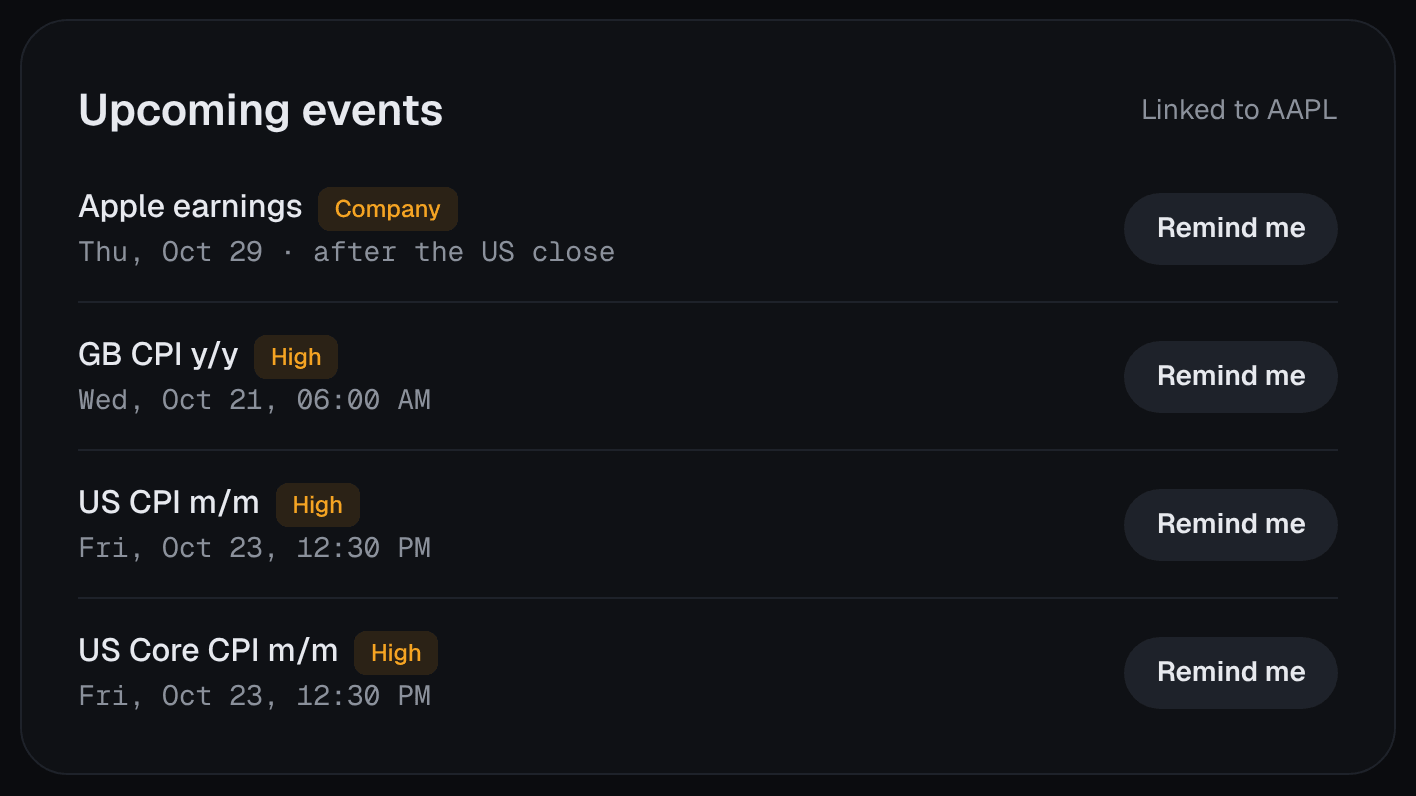
On Traders Portal, a stock's page lists the next report under Upcoming events, with whether it falls before the US open or after the US close, the EPS estimate where available, and a Remind me button that sets an alert.
Gaps and your stop loss
A gap is a jump between one session's last price and the next session's first price, with no trading in between. Your stop loss is a market order once triggered, so if the price opens beyond it, it fills at the first available price.
There is no way to remove this risk, only ways to manage it. You can close before the report, trade after the report once the gap has happened, or hold with a size small enough that a large gap is acceptable. If 120 USDT is the most you will lose and you think a 15-point gap is plausible, the size is 120 ÷ 15 = 8 shares, not 20.
Dividends and costs
When a company pays a dividend, its share price usually drops by about the dividend amount on the ex-dividend date, the first day new buyers no longer qualify. CFD holders do not receive the dividend itself, but positions are commonly adjusted so the drop does not unfairly hit one side: buy positions are typically credited and sell positions debited. Corporate actions such as stock splits can also lead to adjustments.
Costs follow the usual pattern. You pay the spread, the trade fee (the fee shown in the order panel before you confirm), and a swap on positions held past the daily swap time shown in the market details, charged on weekdays with three days' worth on the triple-swap day shown in the market details. Each stock's page shows its Swap long / short rates. See Trading Costs for how these add up, and Fundamental Drivers for the economic data that moves whole markets.
Before you trade a stock CFD
- Check the session
Confirm the market is open and how long remains until the close.
- Check upcoming events
Look for an earnings date or major economic release before you plan to close.
- Size for the stop and the gap
Work out the loss at your stop, then run the gap test. Use the smaller size.
- Set TP / SL
Place a stop loss on every trade, as covered in Stop Loss and Take Profit, knowing it cannot protect you fully from a gap.
Conclusion
A stock CFD lets you trade a company's share price in either direction from your USDT account, without owning the shares. The key difference from crypto is time: stocks trade in sessions, and the most dangerous moves often happen while the market is closed. Earnings reports, overnight news and weekends can all open the price beyond your stop. Check the trading hours and upcoming events, size for the gap as well as the stop, and remember that leverage magnifies losses as much as gains.
Related reading
FAQs
- Do I get shareholder rights with a stock CFD?
- No. A stock CFD pays out the change in the share price, settled in USDT. You do not own the shares, so you have no voting rights and receive no shareholder documents.
- Can I trade stock CFDs outside US market hours?
- Only during the trading hours listed for that market, which you can check on its page under Markets. Outside those hours you cannot open or close a position, and the price can move a long way before the next session starts.
- What happens to my stop loss if a stock gaps?
- A stop loss becomes a market order once the price reaches it. If the market opens beyond your stop, the stop is filled at the first available price, which can be much worse than the level you set.
- Do stock CFDs pay dividends?
- You do not receive the dividend itself, but CFD positions are commonly adjusted when a share goes ex-dividend: buy positions are usually credited and sell positions debited. Any adjustment would show in your account history.
- Is trading an index less risky than trading a single stock?
- An index spreads company-specific risk across many companies, so one earnings report moves it far less than it moves a single share. Indices still fall with the broad market, can gap and are leveraged, so the same risk rules apply.