Funding/Overnight Fees, Swaps and Trading Costs
What a trade really costs: the spread, the trade fee, the daily swap and slippage, how swaps differ from crypto funding rates, and a worked cost example in USDT.
Every trade has a price tag, and it is easy to miss because it is not shown as one number. On Traders Portal there are three explicit costs: the spread built into the buy and sell prices, the trade fee, and the swap, a daily charge or credit for holding a position overnight. On top of those sits slippage, the gap between the price you expected and the price you got.
Each cost is small on a single trade. Together, and repeated over many trades or many days, they can decide whether a strategy makes or loses money. This lesson explains each one, how a CFD swap differs from the funding rates you may know from crypto exchanges, and how to add them up in USDT.
Open a trade on Traders Portal
The spread
Every market shows two prices. You buy at the Ask and sell at the Bid, and the gap between them is the spread. Because you open at one side and close at the other, a new position starts slightly in the red. The cost is simply the spread times your size: a 30 USDT spread on 0.1 BTC is 0.1 × 30 = 3 USDT.
Spreads are not fixed. They tend to widen when markets are thin, around the open of a session and around major news. Bid, Ask, Spread and Why They Matter covers this in depth.
The trade fee
The trade fee is the fee shown in the order panel before you confirm, on the line labeled Fee in the order summary. After the trade, it appears in the Fees column of Closed Positions. Depending on the market, the fee may be a percentage of the position value charged when you open and again when you close, or a flat amount per trade. Each market's page under Markets explains which applies.
The swap: the overnight cost
A swap is a daily adjustment for keeping a position open past the daily swap time shown in the market details. It reflects the cost of financing a leveraged position, and it is calculated as:
Swap = position value × the market's long or short swap rate
Buy and sell positions have separate rates. A negative rate is charged to you; a positive rate is credited. A market's page shows Swap long / short as a percentage per day, and when it is charged.
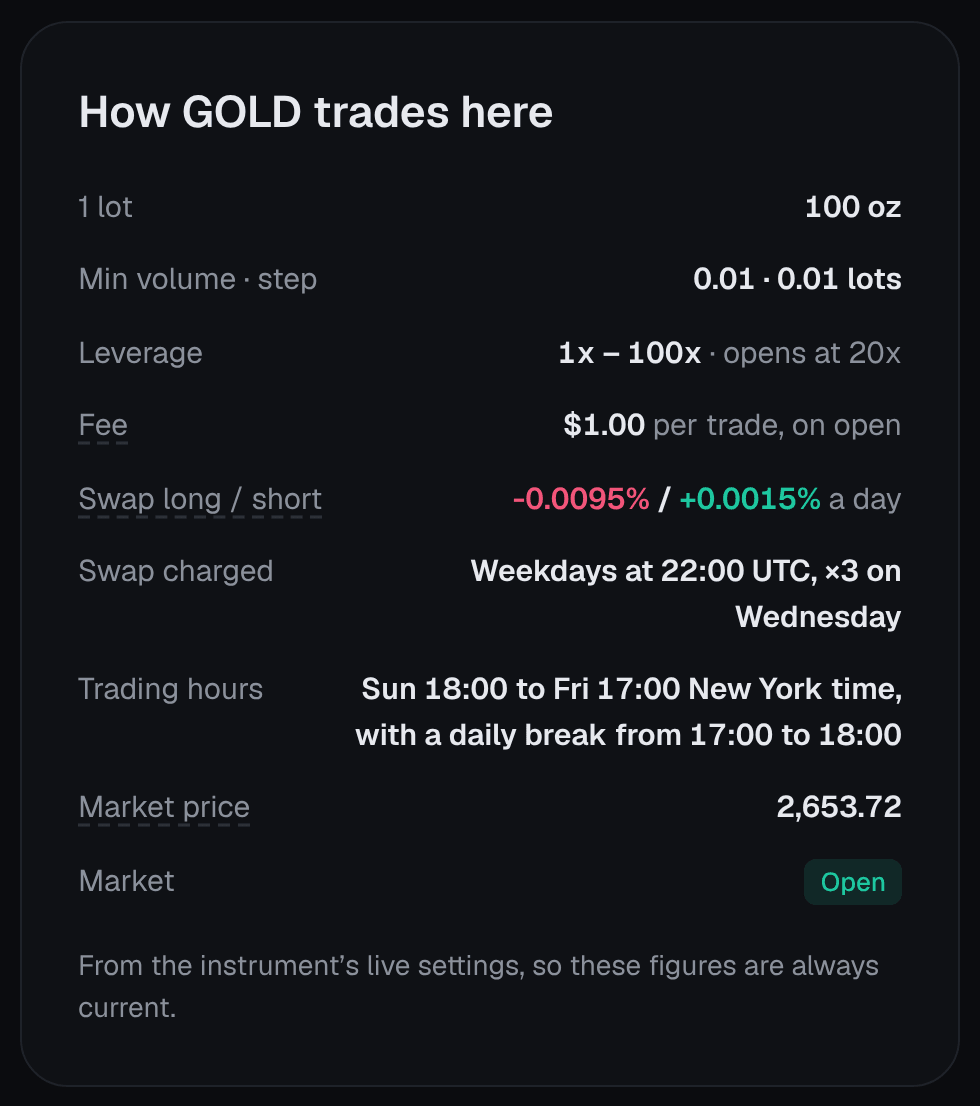
Markets other than crypto are charged on weekdays only, with three days' worth on the triple-swap day shown in the market details to cover the weekend. Crypto markets are charged every day. Swap counts in your equity while the position is open, and shows in the Swap column of Closed Positions afterwards.
Funding rates, and why you won't pay them here
Many crypto exchanges offer perpetual futures, futures contracts with no expiry date. To keep their price close to the spot price, they use a funding rate: at fixed intervals, often every eight hours, traders on one side pay traders on the other. When funding is positive, longs pay shorts; when negative, shorts pay longs. The rate changes with how traders are positioned.
Traders Portal does not offer perpetual futures, so there is no funding rate on your positions. Every market is a CFD with a daily swap instead. Funding rates are still worth knowing about as outside market data, because they hint at how crowded one side of the crypto market is. Market Sentiment explains how traders read them.
| Funding rate | Swap on Traders Portal | |
|---|---|---|
| Where it applies | Perpetual futures on crypto exchanges | CFDs on every market |
| How often | Fixed intervals, often several times a day | Once a day |
| Who receives it | Traders on the other side | Charged to or credited to your account |
| How the rate is set | Moves with market positioning | Set per market, separately for long and short |
| Weekends | Charged as normal | Crypto every day; other markets triple on one weekday |
Slippage: the cost nobody quotes
Slippage is the difference between the price you expected and the price you were filled at. Market orders and triggered stop losses fill at the next available price, so in a fast market or a gap they can fill worse than expected. It is not a fee, but it is a real cost. Limit orders avoid it by filling only at your price or better, at the risk of not filling at all.
Adding it all up
Costs took nearly a fifth of that gain. Held for 30 days instead of 5, the swap alone would be 30 × 1.80 = 54 USDT. For markets other than crypto, a full week always includes one triple day: a gold position charged 2.40 USDT a day pays five weekday charges, one of them tripled, so 7 × 2.40 = 16.80 USDT for the week.
Check your costs before and after
- Before: read the prices and the summary
Look at the Bid and Ask on the trade screen, then read Fee and Margin required in the order summary.
- Before: check the swap
On the market's page, note Swap long / short and when swap is charged if you might hold overnight.
- After: compare gross and net
In Closed Positions, compare Fees, Swap and Net PnL with the price move. Record them in your journal.
Conclusion
Trading costs come in four forms: the spread you cross to open, the trade fee, the daily swap and slippage in fast markets. All are worked out on the full position value, so leverage does not shrink them. Crypto exchanges' funding rates do not apply on Traders Portal, where a daily swap takes their place. Check the costs before each trade, keep an eye on holding time, and compare gross and net results afterwards. Many traders who look profitable before costs are not after them.
Related reading
FAQs
- Does Traders Portal charge crypto funding rates?
- No. Funding rates belong to perpetual futures on crypto exchanges. Every market on Traders Portal is a CFD, which uses a daily swap instead, set per market and charged once a day.
- Why was I charged three days of swap at once?
- Markets other than crypto do not charge swap at weekends. To cover those two days, one weekday carries a triple charge, shown as the triple-swap day in the market details.
- Can a swap be paid to me instead of charged?
- Yes. Each market has separate long and short swap rates. A negative rate is charged to your account and a positive rate is credited to it.
- Does leverage increase my trading costs?
- The spread, fee and swap are all worked out on the full position value, not on your margin. Leverage itself does not change the rate, but it lets you open a larger position with the same money, and larger positions cost more.
- How can I avoid paying swap?
- Swap only applies to positions still open at the daily swap time, so trades opened and closed within the same day before that time pay none. The spread and the trade fee still apply.